Burr vs Blade Coffee Grinders
As an Amazon Associate I earn from qualifying purchases.
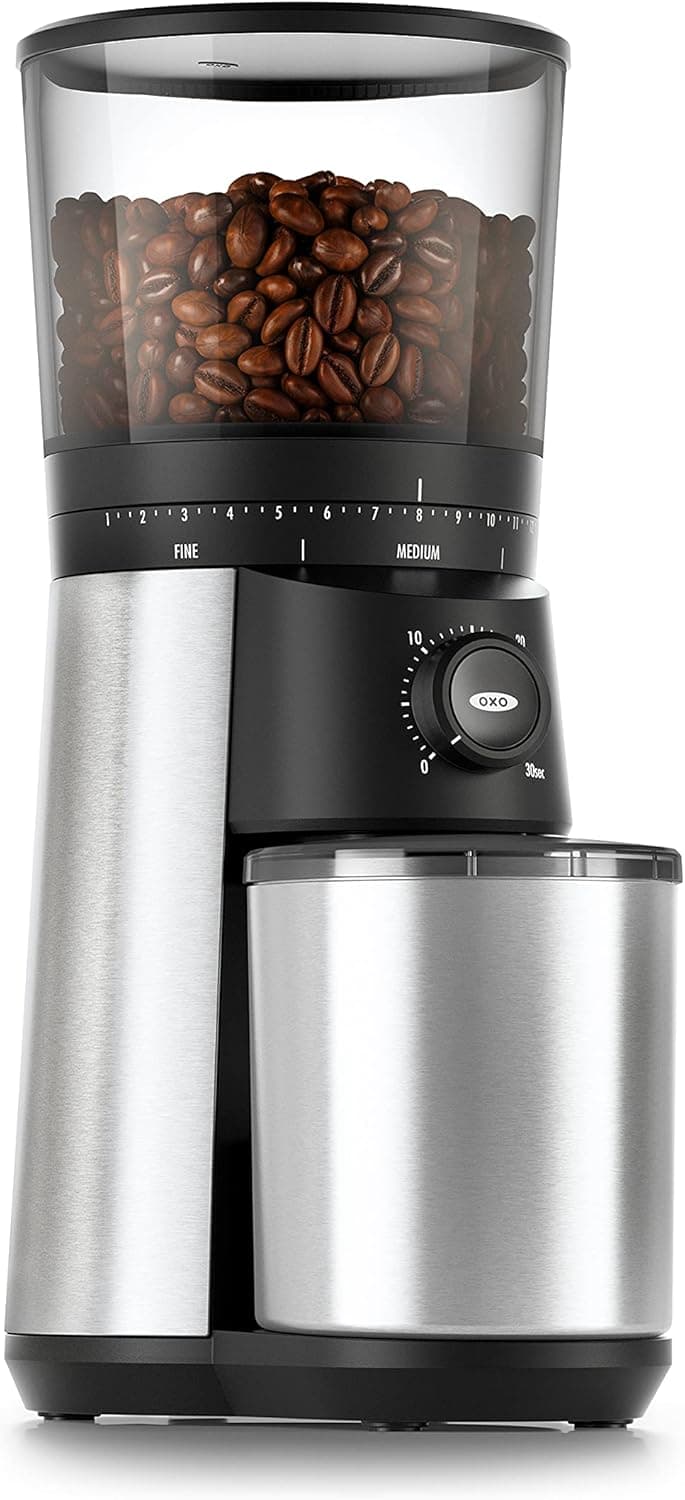
If you are serious about better coffee at home, the grinder is where the difference is made or lost. The two main types are blade grinders and burr grinders, and they work in fundamentally different ways. Understanding that difference explains why experienced home baristas almost always recommend one over the other, and why the cheaper option often disappoints.
A blade grinder works like a tiny propeller. A spinning blade chops the beans into whatever pieces happen to land in its path. Run it longer and you get finer particles, but you also get a chaotic mix of dust and large chunks in the same batch. This unevenness is the core problem. During brewing, the fine dust over extracts and turns bitter while the big chunks under extract and stay sour, so the cup tastes muddled no matter how careful the rest of your process is.
A burr grinder takes a different approach. It crushes beans between two abrasive surfaces, called burrs, set a fixed distance apart. Because the gap is consistent, the particles come out at a much more uniform size. That uniformity is the whole game in coffee. When particles are similar in size, water extracts flavor from them at a similar rate, and the result is a cleaner, sweeter, more balanced cup with far more control.
Control is the other major advantage of burrs. Burr grinders let you select a specific setting, from very fine for espresso to coarse for a French press, and return to it reliably. Blade grinders offer no real settings at all, just how long you hold the button, which makes it nearly impossible to repeat a good result or brew methods like espresso that demand a precise, consistent fine grind.
Burr grinders themselves come in two flavors: flat burrs and conical burrs. Both produce a consistent grind, and for most home brewers the practical differences are subtle compared to the leap up from a blade. More important is choosing a grinder whose range covers your brewing. If you pull espresso, make sure the model handles a fine, adjustable espresso grind, since many inexpensive burr grinders are built mainly for drip and struggle at the fine end.
So which should you buy? For anyone brewing pour-over, drip, French press, or espresso, a burr grinder is the clear choice and often the highest impact upgrade you can make. A blade grinder is only worth considering as a bare bones stopgap, or for grinding spices. If the budget is tight, a modest burr grinder paired with a simple brewer will beat an expensive machine fed by a blade grinder every single time. Put your money in the grind first, and the rest of your setup gets easier.