Milk Frothing Techniques
As an Amazon Associate I earn from qualifying purchases.
Beautifully steamed milk turns a plain espresso into a cappuccino or latte with a glossy, paint-like texture that pours smoothly and tastes sweet. The goal is microfoam, a mass of tiny bubbles so fine the milk looks like wet paint rather than the stiff, dry foam of a cheap machine. Learning to steam well is a skill of the hands and ears, and it improves quickly with focused practice.
Start with cold milk and a clean, dry pitcher filled somewhere between a third and half full, because milk expands as you froth it. Cold milk gives you more time to work before it overheats, and a well-sized pitcher lets you create a whirlpool without splashing. Purge the steam wand first to clear any condensation, then position the tip just below the surface of the milk near one side of the pitcher to set up the spin.
Think of steaming in two phases. The first is stretching, sometimes called the aeration phase, where you keep the tip near the surface so it pulls in air and you hear a gentle, steady hissing or paper-tearing sound. This is where you build volume, and for a latte you want only a little, while a cappuccino takes more. The second phase is texturing, where you sink the tip slightly deeper to stop adding air and instead spin the milk into a smooth vortex that folds the big bubbles into fine ones.
Your ears and hands are your instruments. A loud screeching or gurgling means the wand is too shallow and you are adding air too aggressively, producing large bubbles that will never smooth out. A silent pitcher with no rolling motion means the tip is too deep and you are only heating, not texturing. Aim for a quiet, consistent whirlpool and touch the side of the pitcher with your hand to judge temperature, stopping when it becomes uncomfortably hot to hold.
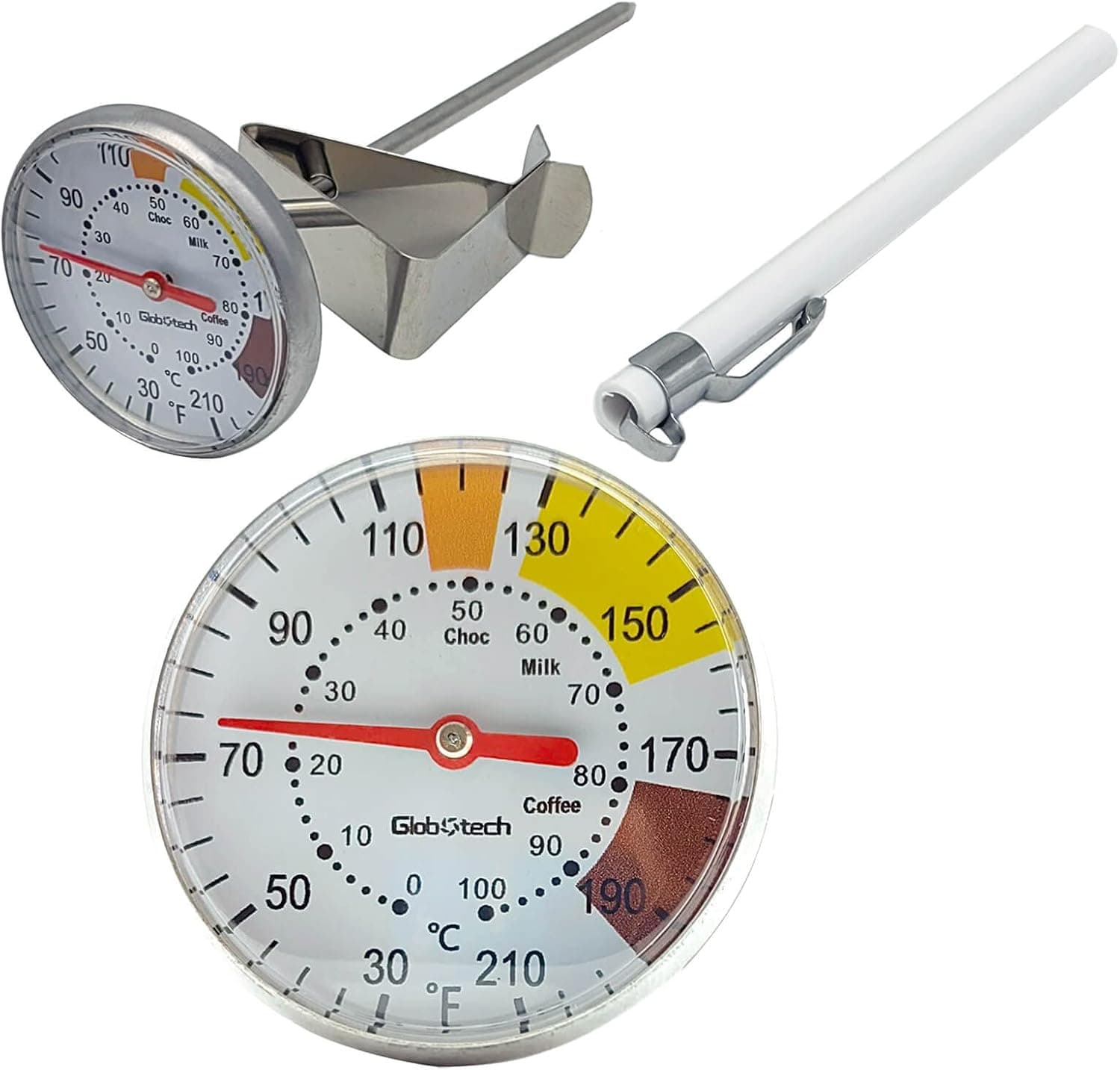
Temperature control keeps the milk sweet. Overheated milk scalds, loses its natural sweetness, and can taste eggy, while under-heated milk feels thin. Most people target something in the range where the pitcher is too hot to hold comfortably for more than a moment, and a small thermometer removes the guesswork while you learn. Once you stop, give the pitcher a firm tap on the counter to pop any remaining large bubbles and a gentle swirl to keep the milk glossy and integrated.
Different milks behave differently, so expect to adjust. Whole dairy milk is forgiving because its fat and protein create stable, sweet foam, while skim milk froths easily but can turn stiff and dry. Plant-based milks vary a great deal, and barista-specific versions are formulated with added stabilizers to steam more like dairy. Practice with one milk until your technique is reliable, then experiment, and clean the wand immediately after every use so dried milk never becomes a problem.